Sine wave combinator
Sum four sine waves in real time and change their frequencies to watch a composite trace separate into the rhythms underneath it. This is the idea every spectrogram rests on, and the quickest way to make it concrete.
A curated video curriculum and primary literature on EEG-guided pediatric anesthesia — free to view, designed for clinicians who want to start reading the brain in the operating room today.
Our recommended starting point is the EEG for Anesthesia YouTube channel — a concise, evidence-based introduction to the EEG signal and how anesthetic drugs shape it. PALNET's in-OR teaching and workshops build directly on this foundation.
Current standards for assessing depth of anesthesia rely on indirect measures — heart rate, blood pressure, muscle tone, and presumed drug interactions. Modern systems-level neuroscience now lets us link recognizable EEG signatures to the anesthetic states produced by most commonly used drugs. Familiarity with these signatures helps anesthesia clinicians make more detailed and accurate assessments of the anesthetic state of their patients. These videos provide a brief, accessible introduction to the EEG signal as it relates to altered states of arousal caused by anesthesia.
Three browser-based simulations built by SmartTIVA, a PALNET collaborator. Unlike a video or a paper, these let you change the inputs and watch the signal respond — the learning is active rather than passive. Nothing to install, and they run on a laptop or a phone.
Sum four sine waves in real time and change their frequencies to watch a composite trace separate into the rhythms underneath it. This is the idea every spectrogram rests on, and the quickest way to make it concrete.
Rotate a spectrogram in three dimensions to see how the familiar flat heat map is built — frequency, time and power stacked into a single surface. Useful for anyone reading the vertical DSA used in neuromonitoring.
Signal and noise, grounded in Ohm's law, with the clinical scenarios that degrade a trace in theatre. Artifact is one of the hardest things to teach at the bedside — here you can generate it deliberately and see what it does.
The order above is a suggestion — the artifact sandbox makes most sense once you can recognise a normal trace. These simulations are hosted by SmartTIVA and open in a new tab; PALNET does not control their content.
PALNET's smart-phone reference tables — built to keep on your phone or print for the OR. Each is an educational aid; always verify against your institution's protocols and the individual patient.
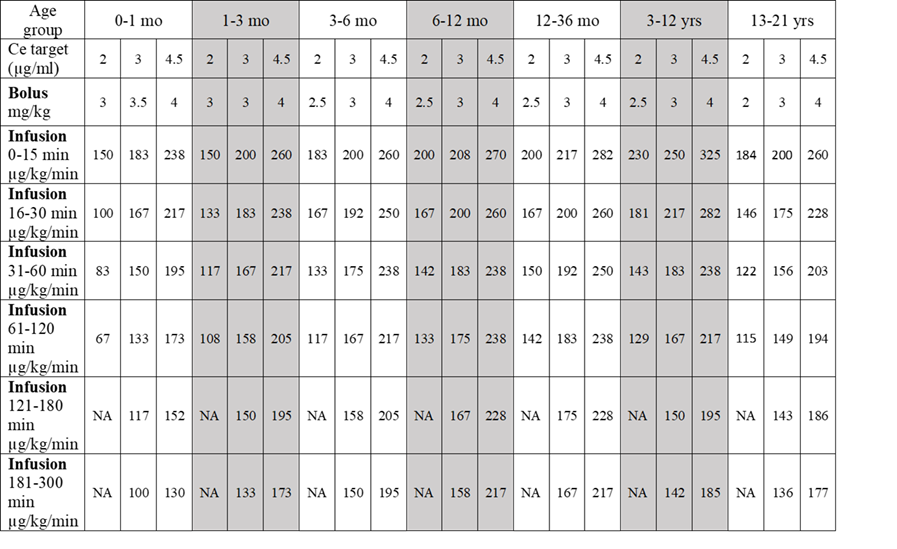
After a sevoflurane mask induction, the bolus dose should be infused over minutes — allowing the sevoflurane level to decrease to prevent hypotension.
Educational reference only. Verify all dosing against your institution's protocols, current drug references, and the individual patient.
PALNET · pedseeg.com · Smart-phone reference tables (June 2026)
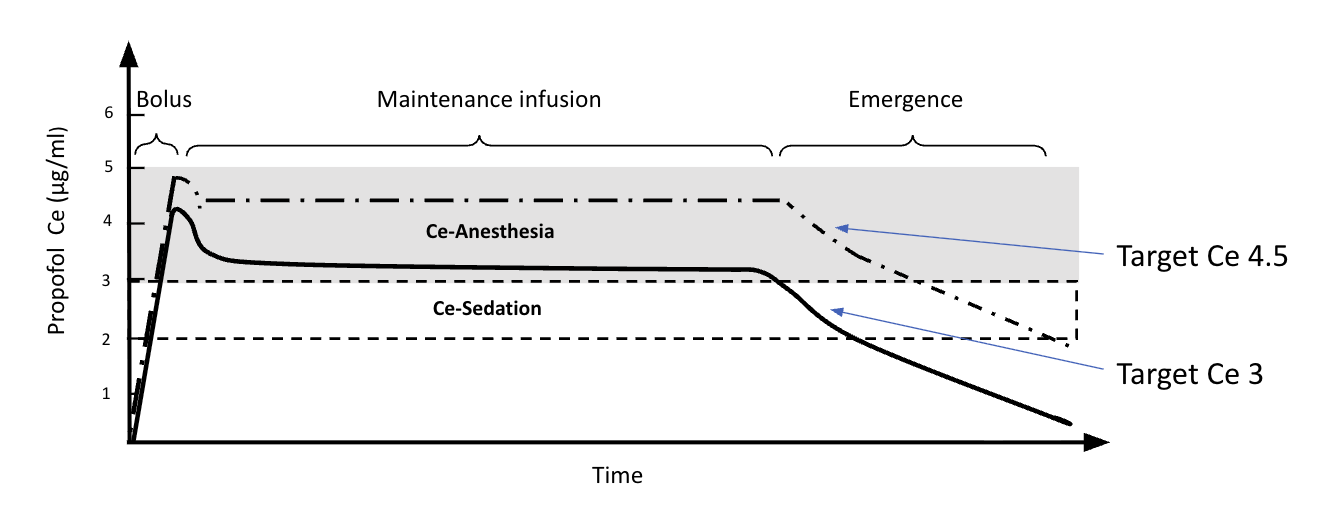
Educational reference only. A conceptual illustration; verify dosing and targets against your institution's protocols and the individual patient.
PALNET · pedseeg.com · Smart-phone reference tables (June 2026)
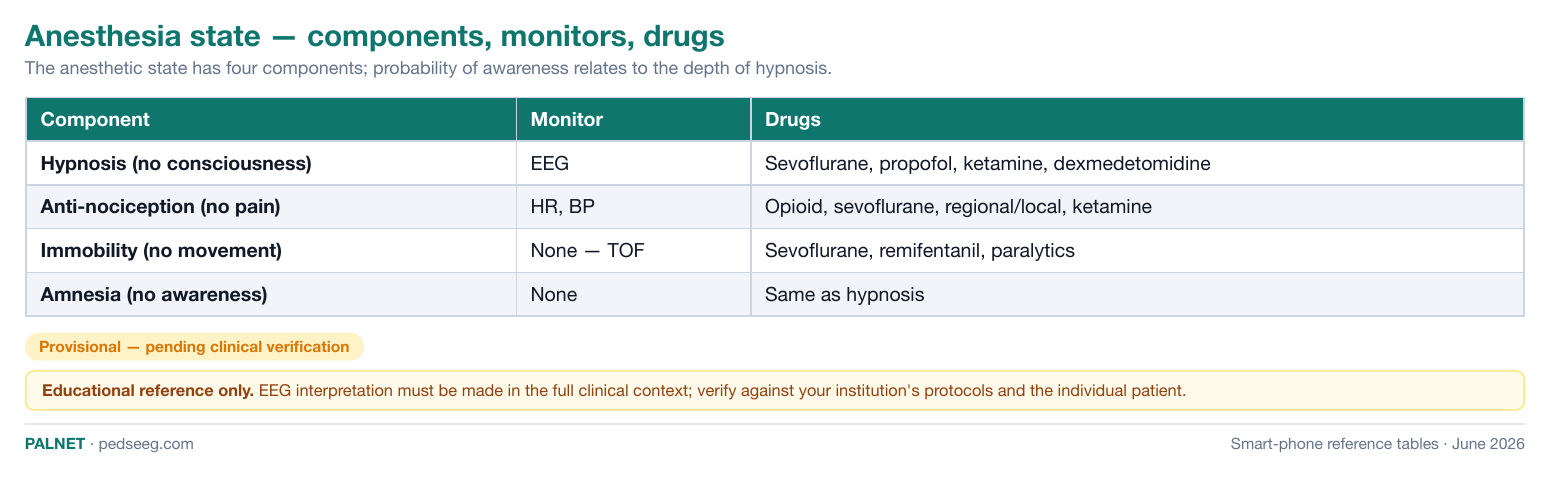
| Component | Monitor | Drugs |
|---|---|---|
| Hypnosis (no consciousness) | EEG | Sevoflurane, propofol, ketamine, dexmedetomidine |
| Anti-nociception (no pain) | HR, BP | Opioid, sevoflurane, regional/local, ketamine |
| Immobility (no movement) | None — TOF | Sevoflurane, remifentanil, paralytics |
| Amnesia (no awareness) | None | Same as hypnosis |
Educational reference only. EEG interpretation must be made in the full clinical context; verify against your institution's protocols and the individual patient.
PALNET · pedseeg.com · Smart-phone reference tables (June 2026)
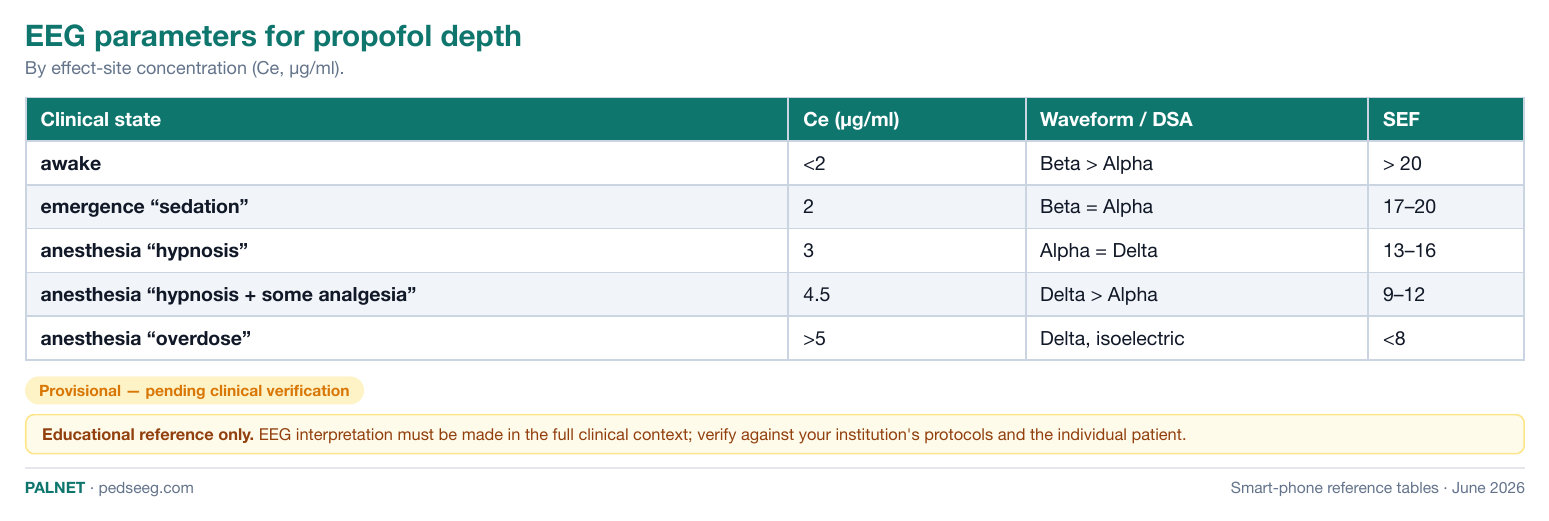
| Clinical state | Ce (µg/ml) | Waveform / DSA | SEF |
|---|---|---|---|
| awake | <2 | Beta > Alpha | > 20 |
| emergence “sedation” | 2 | Beta = Alpha | 17–20 |
| anesthesia “hypnosis” | 3 | Alpha = Delta | 13–16 |
| anesthesia “hypnosis + some analgesia” | 4.5 | Delta > Alpha | 9–12 |
| anesthesia “overdose” | >5 | Delta, isoelectric | <8 |
Educational reference only. EEG interpretation must be made in the full clinical context; verify against your institution's protocols and the individual patient.
PALNET · pedseeg.com · Smart-phone reference tables (June 2026)
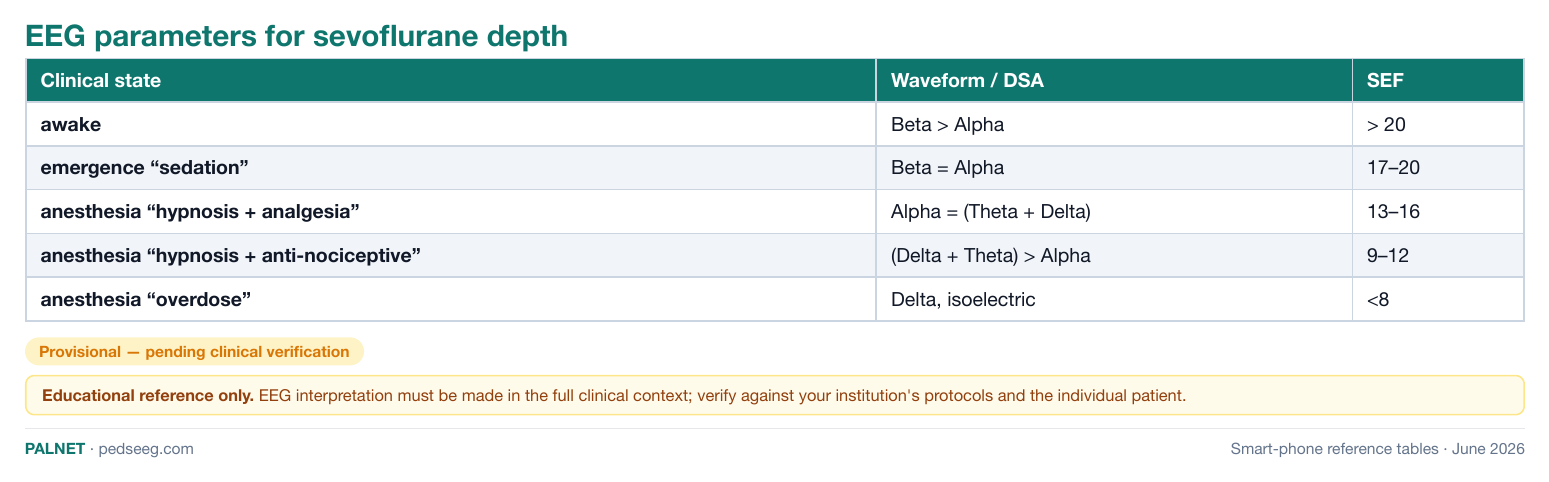
| Clinical state | Waveform / DSA | SEF |
|---|---|---|
| awake | Beta > Alpha | > 20 |
| emergence “sedation” | Beta = Alpha | 17–20 |
| anesthesia “hypnosis + analgesia” | Alpha = (Theta + Delta) | 13–16 |
| anesthesia “hypnosis + anti-nociceptive” | (Delta + Theta) > Alpha | 9–12 |
| anesthesia “overdose” | Delta, isoelectric | <8 |
Educational reference only. EEG interpretation must be made in the full clinical context; verify against your institution's protocols and the individual patient.
PALNET · pedseeg.com · Smart-phone reference tables (June 2026)
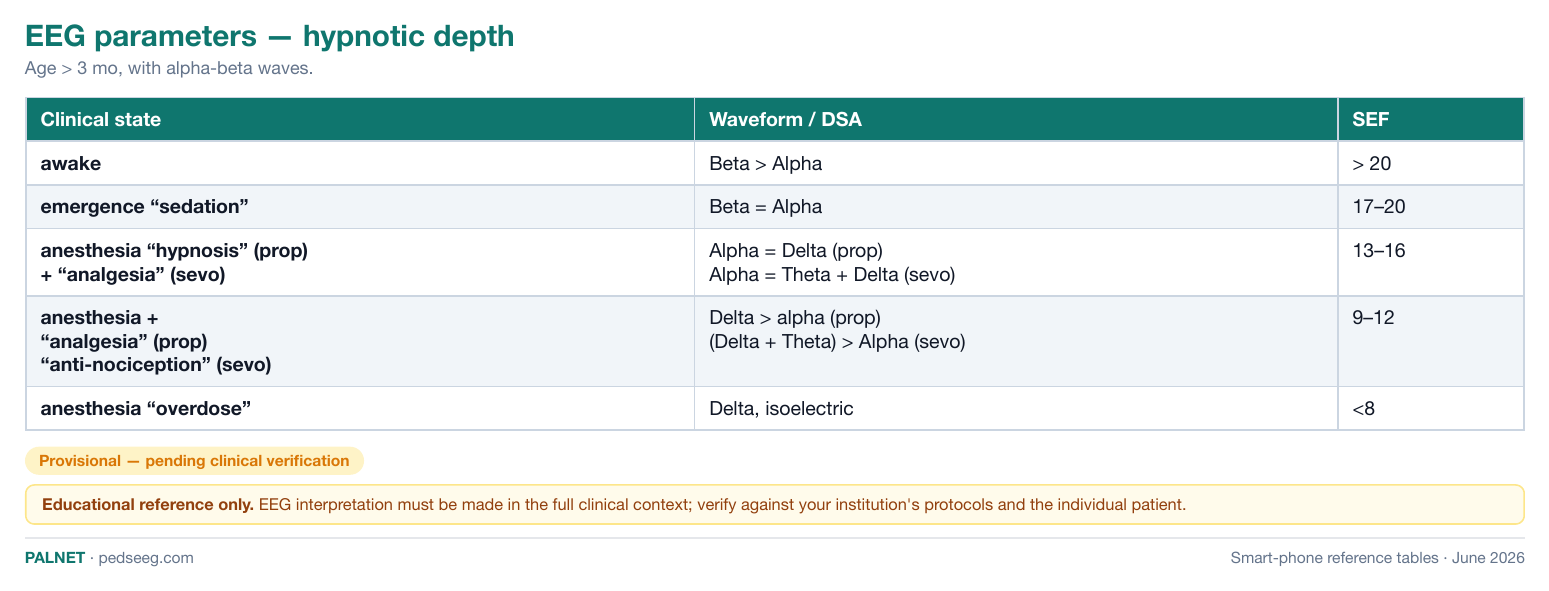
| Clinical state | Waveform / DSA | SEF |
|---|---|---|
| awake | Beta > Alpha | > 20 |
| emergence “sedation” | Beta = Alpha | 17–20 |
| anesthesia “hypnosis” (prop) + “analgesia” (sevo) | Alpha = Delta (prop) Alpha = Theta + Delta (sevo) | 13–16 |
| anesthesia + “analgesia” (prop) “anti-nociception” (sevo) | Delta > alpha (prop) (Delta + Theta) > Alpha (sevo) | 9–12 |
| anesthesia “overdose” | Delta, isoelectric | <8 |
Educational reference only. EEG interpretation must be made in the full clinical context; verify against your institution's protocols and the individual patient.
PALNET · pedseeg.com · Smart-phone reference tables (June 2026)
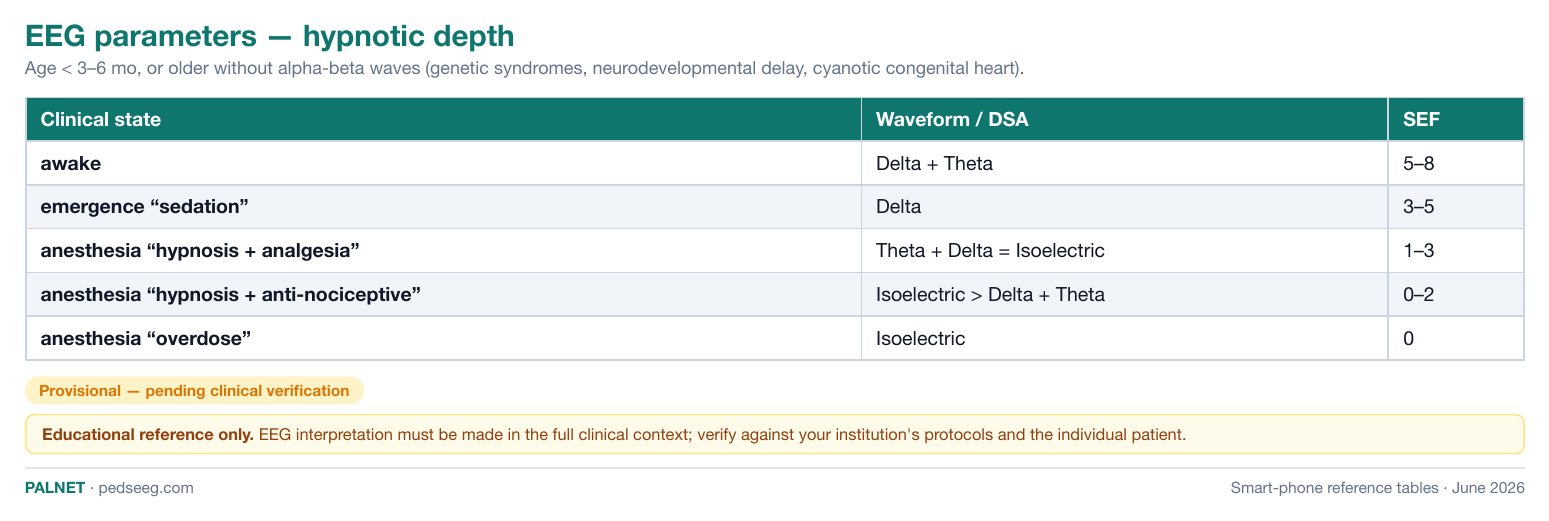
| Clinical state | Waveform / DSA | SEF |
|---|---|---|
| awake | Delta + Theta | 5–8 |
| emergence “sedation” | Delta | 3–5 |
| anesthesia “hypnosis + analgesia” | Theta + Delta = Isoelectric | 1–3 |
| anesthesia “hypnosis + anti-nociceptive” | Isoelectric > Delta + Theta | 0–2 |
| anesthesia “overdose” | Isoelectric | 0 |
Educational reference only. EEG interpretation must be made in the full clinical context; verify against your institution's protocols and the individual patient.
PALNET · pedseeg.com · Smart-phone reference tables (June 2026)
Educational reference only. EEG interpretation must be made in the full clinical context; verify against your institution's protocols and the individual patient.
PALNET · pedseeg.com · Smart-phone reference tables (June 2026)
PALNET's official reading list — curated and vetted by our PALNET teachers and used over the past year. These articles are frequently cited in PALNET's own publications. Citations link to the publisher (DOI) where available.
Additional papers organized by topic. Click any heading to expand. These have not been endorsed by PALNET leadership and are listed here only as background for human review.
PALNET links to canonical publisher pages rather than hosting PDFs directly, in keeping with academic publishing licenses. If a paper is available open-access through the journal or PubMed Central, the DOI link will resolve to that version automatically.
A PALNET site visit brings two days of in-OR, case-based teaching directly to your institution — followed by ongoing mentorship.